

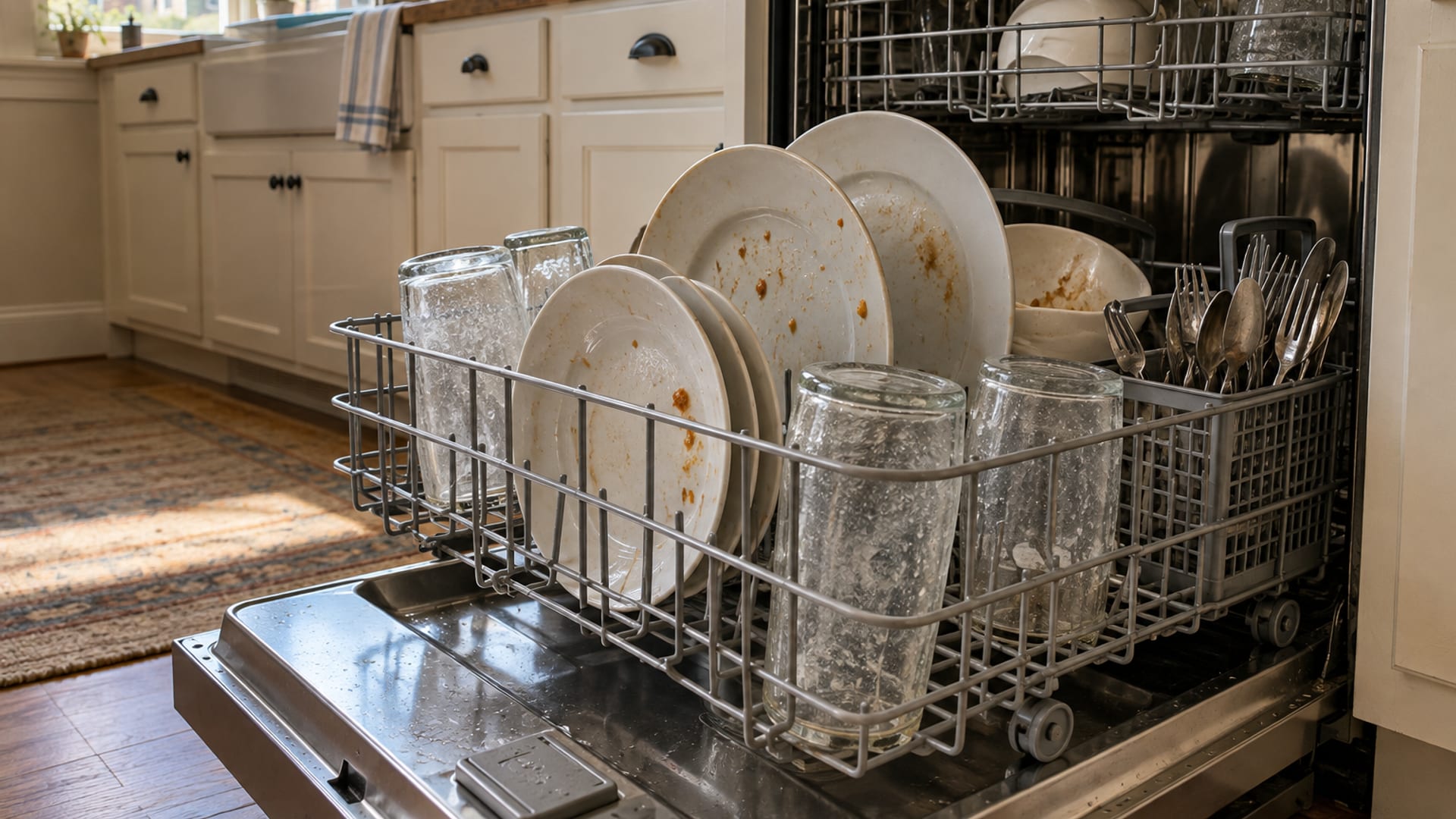
If your dishes come out with grit on the glasses, a film on the plates, or food still stuck to the forks, the dishwasher isn't broken as often as people think. Most of these calls trace back to four things a homeowner can check in an afternoon, plus two that need a technician. Here's how Joey works through it in Huntington kitchens.
Clean the Filter First — It Fixes Half of These Calls
Dishwashers built in the last fifteen years or so don't have a food grinder. They rely on a fine mesh filter under the lower spray arm that you're supposed to pull and rinse every few weeks. Almost nobody does. When it clogs, the wash water is recirculated through a layer of old food, and that's what gets sprayed back on your dishes.
- Pull the lower rack and lift out the spray arm if it's in the way.
- Twist the round filter cap a quarter turn and lift the assembly out.
- Rinse under hot water, brushing the mesh with an old toothbrush.
- Wipe out the sump underneath and reinstall the filter until it locks.
If the filter was packed, run an empty cycle with dishwasher cleaner and see how the next load looks. It's the single most effective thing you can do.
Clogged Spray Arm Holes Leave Grit on Glasses
Each spray arm has a row of small holes that shape the water into jets. Seeds, bits of glass, and mineral scale plug them one at a time. The arm still spins, but the water pattern gets weak and the top rack — always the hardest to reach — stops getting clean. Pop the arms off, clear each hole with a toothpick, and check that they spin freely by hand. A cracked arm sprays water sideways instead of up and should be replaced.
Your Water Needs to Reach 120°F at the Dishwasher
Detergent is designed to work in hot water, and a dishwasher's own heater is meant to hold temperature, not raise it from cold. If the water coming in is lukewarm, the first wash runs cool and grease doesn't lift. Run the kitchen faucet until it's hot before you start the dishwasher — that clears the cold water sitting in the pipe. If the faucet water doesn't feel genuinely hot, check the water heater setting. Around 120°F is the target. Any hotter wastes energy and can scald; any cooler and your dishwasher fights uphill every cycle.
Detergent and Rinse Aid Matter More Than People Think
A few things Joey sees over and over:
- Too much detergent. Powder and gel are dosed for hard water; in a full cup they leave residue. Pods solve this for most homes.
- Old detergent. Powder that's been under the sink for a year clumps and loses strength.
- An empty rinse aid dispenser. Rinse aid isn't optional on modern dishwashers. It's what makes water sheet off glassware instead of drying in spots, and most drying complaints are really rinse aid complaints.
Hard Water Film in Outlying Tri-State Homes
Huntington's city water is moderately hard, but homes on wells or smaller systems out toward Milton, Ona, and the Wayne County side often see much harder water. The white haze that builds up on glasses and the inside of the door is mineral scale, not detergent. It won't wash off with more soap. Fill the detergent cup with citric acid or a commercial descaler and run a hot empty cycle every month or two. If the film is heavy, a rinse aid set to its highest dose helps between descaling runs. A water softener solves it for good.
The cloudy glass test. Soak a hazy glass in white vinegar for ten minutes. If it comes out clear, the haze is mineral film — a water problem. If it stays cloudy, the glass is etched from soft water and too much detergent, and no repair or cleaner will reverse it.
When the Circulation Pump Is the Real Problem
If the filter is clean, the arms are clear, and the water is hot, but the dishwasher still sounds quiet during the wash and the arms barely turn, the circulation pump is losing pressure. The motor may be worn, the impeller may be broken, or a piece of glass may be lodged in the pump housing. Sometimes a failed wash pump also fails to drain properly. This is a technician job — the pump sits under the tub and the dishwasher has to come out. Our dishwasher repair and drain pump replacement pages explain how those visits go.
Loading Habits That Undo a Good Dishwasher
- A tall pot or sheet pan in the lower rack blocking the spray arm's rotation
- Bowls nested together so water can't reach inside
- Utensils packed so tightly the jets can't get between them
- The detergent door blocked by a dish on the lower rack so it never opens
Spin the spray arms by hand after loading. If they hit anything, move it.
Dishwasher Repair Help in Huntington
Work through the list above and most dishwashers will start cleaning again. If yours doesn't, or if the wash cycle sounds different than it used to, call Lauren and tell her the brand and what the dishes look like coming out. Joey works on Bosch, KitchenAid, Whirlpool, GE, Samsung, and the luxury built-ins, and he'll tell you honestly whether a pump on an older unit is worth the repair.