

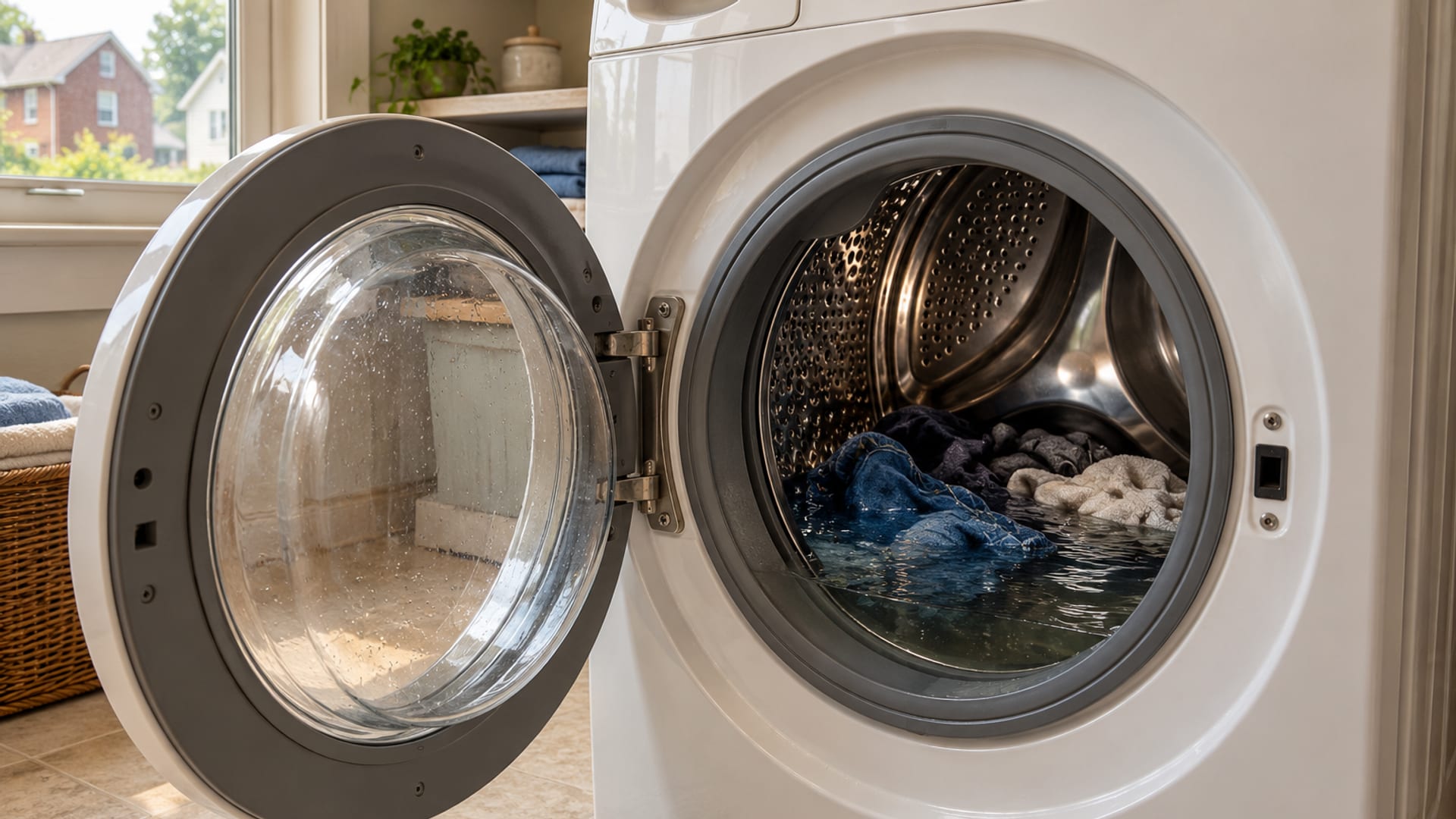
You open the lid and the tub is still full of water, or the clothes come out sopping wet because the spin never happened. Both problems land in the same category, and both usually have simple causes. Here's the order Joey checks things in, so you can rule out the easy stuff before you call.
First, Figure Out Which Problem You Actually Have
Washers won't spin until they've drained, so a drain problem shows up as a spin problem too. Watch a cycle. If the water never leaves the tub, you have a drain issue. If the water drains but the drum never picks up speed, you have a spin issue — a lid switch, door lock, motor coupling, or a load-balance problem. Knowing which one saves a lot of guessing.
Check the Drain Hose for a Kink or a Siphon
The gray hose from the washer to the standpipe is the first suspect. Washers pushed hard against the wall crush it. Hoses pushed too far down the standpipe create a siphon that drains the tub during the fill, or a seal that prevents draining at all. The hose should have a loop at least as high as the top of the tub and go no more than a few inches into the drain. Pull the washer out and look — it takes two minutes.
Clean the Pump Filter Before You Call Anyone
Most front-load washers, and a growing number of top-loaders, have a pump filter behind a small door at the bottom front. It catches coins, hair ties, socks, and bra underwires before they reach the pump. When it clogs, the washer drains slowly or not at all and often throws a drain error. Cleaning it is a homeowner job:
- Put a shallow pan and towels under the door — a full tub of water will come out.
- Drain through the small hose first if your model has one.
- Unscrew the filter, pull the debris, rinse it, and reinstall it snug.
- Run a rinse-and-spin cycle to confirm it drains.
Older top-load Whirlpool, Maytag, and Kenmore machines don't have an accessible filter — the pump has to be pulled to clear it. That's a service call.
When the Drain Pump Itself Has Failed
If the hose is clear and the filter is clean, the pump is next. A pump that hums but doesn't move water usually has a broken impeller or a seized bearing. One that's silent may have an open winding. Pumps also crack and leak, which shows up as a puddle under the washer during the drain phase. Replacing the pump is one of the most common washer repairs Joey does, and on most brands it's a part he carries. Our drain pump replacement page walks through what's involved.
Lid Switches and Door Locks Stop the Spin
Every washer has a safety interlock. Top-loaders use a lid switch; front-loaders use a door lock. When either fails, the washer will usually fill and agitate but refuse to spin, because the control board never gets the "door is closed" signal. On some models it won't drain either. Signs include a lid that doesn't click when you close it, a door lock that doesn't buzz at the start of the cycle, or a door that stays locked after the cycle ends.
An Unbalanced Load Will Stall a Spin Cycle
Modern washers sense an unbalanced drum and will slow or stop the spin rather than walk across the floor. One heavy comforter, a single bath mat, or a load of jeans bunched on one side is enough. The washer may try to redistribute several times, then quit with wet clothes. Rearrange the load and run a spin-only cycle. If a balanced load still won't spin, the problem is mechanical — suspension rods, a worn clutch, or a stretched belt — and it's worth a washer repair visit.
A note on floors in older Tri-State homes. Washers on a springy wood floor — common in older houses in Huntington's Southside, Barboursville, and Ceredo — trip the off-balance sensor far more often than the same machine on a slab. A set of anti-vibration pads or a plywood sheet under the washer is often the whole fix.
What the Error Codes on Your Washer Mean
Most washers made after about 2010 will tell you what's wrong if you know the code. A few of the common ones:
- Whirlpool, Maytag, Amana: F9 E1 or "LD" — long drain. F5 E2 or "dL" — door lock.
- LG: OE — drain error. dE — door error. UE — unbalanced load.
- Samsung: 5E, SE, or nd — no drain. dC or dE — door. UB or Ur — unbalanced.
- GE: E22 or E23 — drain. E37 — lid lock.
Write the code down before you unplug the machine to reset it — it helps Lauren get the right part on the truck the first time.
Washer Drain Repair Across the Tri-State
If you've checked the hose, cleaned the filter, balanced the load, and the washer still holds water or refuses to spin, something inside has failed. Call and tell Lauren the brand, the model number from inside the lid or door, and what the machine does when it gets to the drain or spin. Joey usually gets to Huntington, Barboursville, Ashland, and the Ohio-side towns within a day or two, and most drain and spin repairs are finished in one visit.