

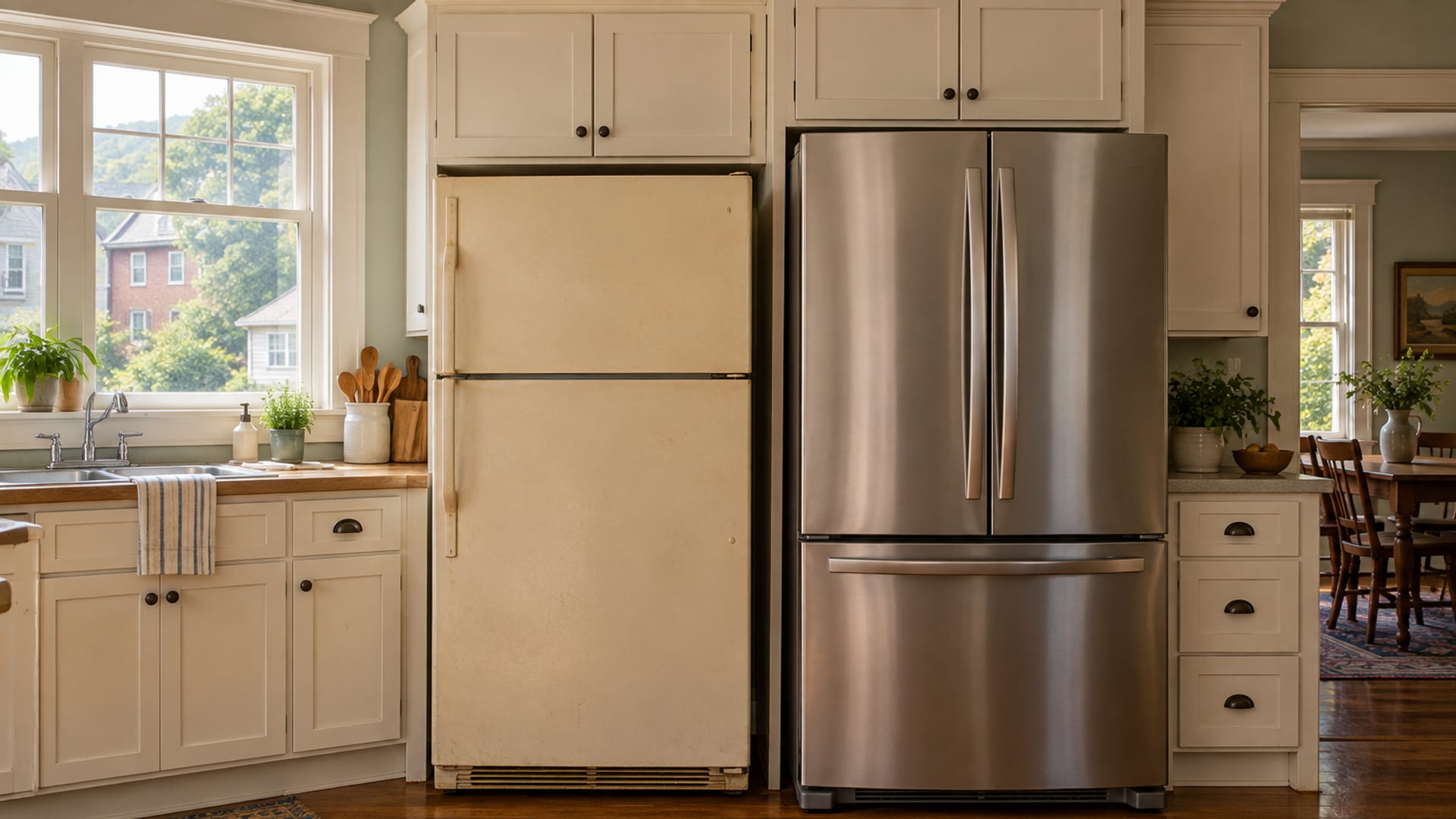
Every week someone in Huntington asks us the same question with a different appliance in front of them: is this worth fixing? It's the right question, and the honest answer depends on three things — what the repair costs, how old the machine is, and what exactly failed. Here's how we work through it on a service call.
Start With the Half-Price Rule
If a repair costs less than half of what a comparable new appliance would run, and the machine is under roughly ten years old, repair it. That single rule settles most calls. A new dryer heating element, a washer drain pump, or an oven igniter is a small fraction of replacement cost, and the rest of the machine still has years in it.
Once the repair creeps past half the replacement price, the math starts to turn — not because the repair won't work, but because you're putting real money into a machine that is also aging everywhere else.
Age Matters, but Not the Way People Think
Appliances don't have a fixed expiration date. A 1990s GE refrigerator we quieted down in Huntington is still running; a six-month-old refrigerator we repaired had already been abandoned by its manufacturer's warranty. What age really tells you is parts availability and how many other components are close to failing.
- Under 8 years: almost always repair. Parts are plentiful and the rest of the machine is sound.
- 8 to 15 years: repair the cheap stuff (belts, elements, pumps, fans); think hard about expensive stuff (compressors, boards, tubs).
- Over 15 years: repair only if the part is inexpensive and still made. We'll check availability before you commit to anything.
What Failed Changes Everything
Two refrigerators of the same age can land on opposite sides of the line depending on the failure. Here's how the common ones break down.
Usually Worth Repairing
- Dryer heating elements, thermal fuses, belts, and roller kits
- Washer drain pumps, lid switches, and door locks
- Oven bake elements, igniters, and temperature sensors
- Refrigerator evaporator fan motors, defrost heaters, and water valves
- Dishwasher pumps, float switches, and door latches
- Ice maker modules and fill valves
Often Not Worth Repairing
- A failed compressor or sealed-system leak on a standard refrigerator over ten years old
- A cracked outer tub or failed bearing assembly on a front-load washer
- A discontinued main control board on an older range or dishwasher
- Multiple failures at once on a builder-grade unit
The luxury-brand exception. Sub-Zero, Wolf, Viking, and Thermador units are built to be repaired for decades, and replacement costs are high. A compressor on a 17-year-old Sub-Zero is often still the right call — we've done exactly that in Huntington more than once.
Don't Forget the Hidden Costs of Replacing
A new appliance isn't just the sticker price. Delivery, haul-away, and installation add up, and a new refrigerator or range may not fit the cutout or hookups in an older Huntington kitchen. Built-in units are the extreme case — swapping a built-in refrigerator can mean cabinet work on top of the appliance itself.
On the other side, newer machines are more efficient, and a refrigerator from the early 2000s can cost noticeably more to run each year than a current model. We factor that in when the numbers are close.
How We Handle It on a Service Call
- Diagnose first. We test the machine and identify the actual failed part — not a guess from the symptom.
- Price the repair. Part cost, labor, and the timeline if the part needs to be ordered.
- Run the rule. Repair cost against replacement cost, adjusted for age and what else looks tired.
- Tell you plainly. If a new machine makes more sense, we say so. If a repair will hold, we say that too.
The decision is always yours. What we promise is that you'll make it with real numbers in front of you — and that we won't sell you a repair we wouldn't do on our own appliances.