

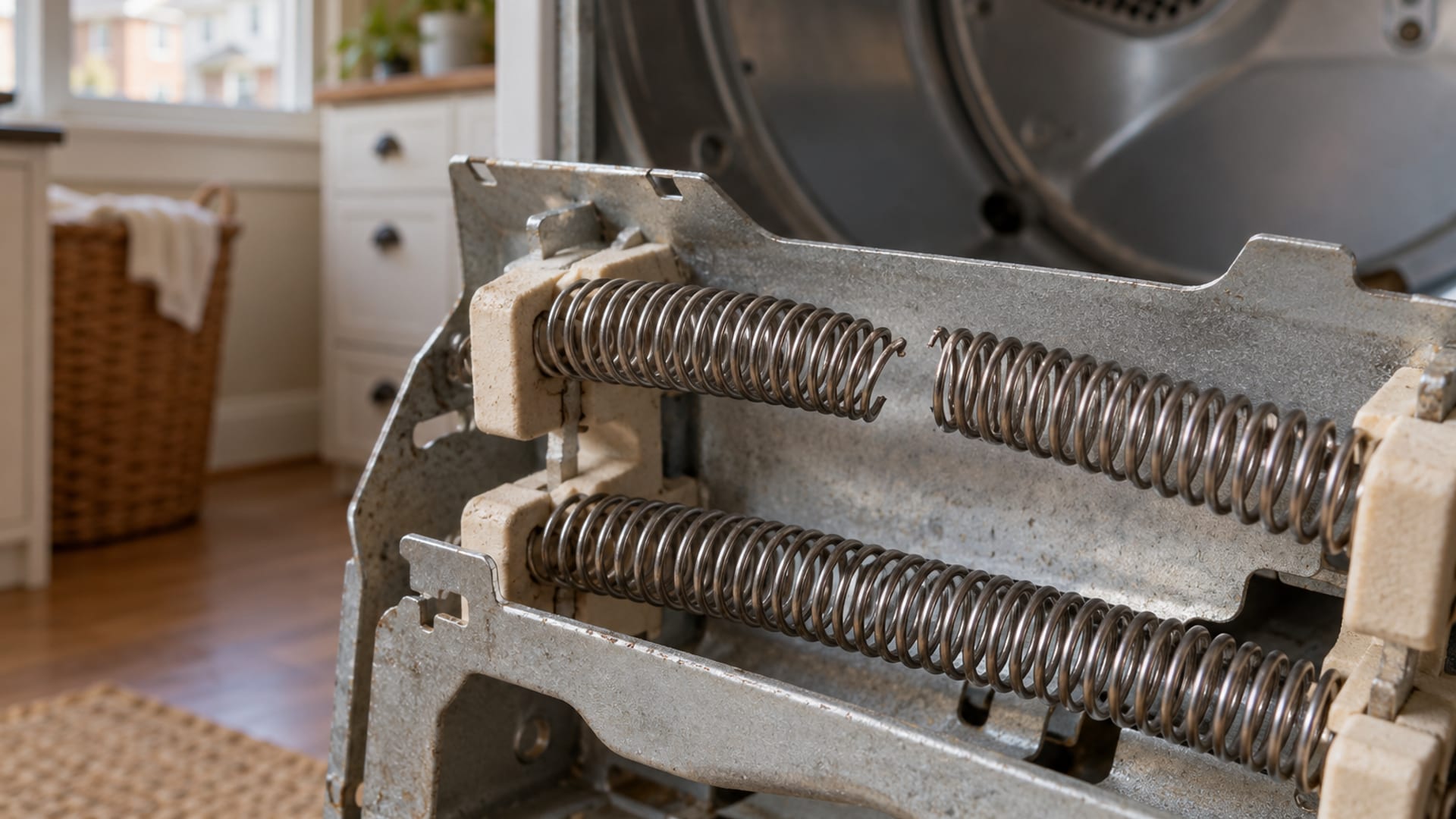
A dryer that tumbles but never gets warm is the single most common laundry call we get across the Tri-State, and the good news is that it's almost always a cheap fix. Five parts account for nearly every no-heat dryer Joey sees. But before we get to them, there's a step most people skip — and skipping it means the new part fails again in six months.
Start with the Vent, Not the Dryer
Almost every no-heat call has the same root cause underneath it: a restricted vent. When lint packs the duct, hot air can't leave the drum. Temperatures climb, safety parts trip, and the dryer either shuts the heat off or burns out the part that was working too hard. Replace the fuse without clearing the vent and you'll be replacing it again.
Huntington's older homes are especially prone to this. Houses in Southside, Westmoreland, and Ceredo often have the laundry in the basement, with a vent run of twenty feet or more that snakes through the joists before it reaches outside. That's a lot of duct to fill with lint. If your vent hasn't been cleaned in a few years, plan on pairing any heat repair with a dryer vent cleaning. The warning signs:
- Clothes take two cycles to dry, even before the heat quit
- The top of the dryer feels hot while it runs
- Little or no air comes out of the outside vent hood
- A burning smell during a cycle
Part One: The Thermal Fuse
The thermal fuse is a one-time safety device on the blower housing. When the exhaust temperature spikes — usually because of that vent restriction — it blows and cuts power to the heater. On many electric dryers the drum still turns, so you get a full cycle of cold air. On some gas models the whole machine stops. The fuse is inexpensive and easy to replace, but it's a symptom, not a cause. Something made it hot enough to blow.
Part Two: The Heating Element on Electric Dryers
An electric dryer's element is a long coil of wire inside a metal housing. Over years of heating and cooling the wire thins and eventually breaks. When it does, the dryer runs normally with no heat at all. A meter check settles it in a minute — an open element reads no continuity. Elements for Whirlpool, Maytag, Kenmore, and GE dryers are common parts and usually on the truck. Samsung and LG elements are a bit more model-specific, but they ship in a few days.
Part Three: The Cycling Thermostat
The cycling thermostat is what turns the heat on and off during a cycle to hold the drum at the right temperature. When it fails open, the heater never gets the signal to come on. When it fails closed, the dryer overheats until the high-limit or the fuse steps in. Either way, the fix is a small thermostat mounted on the blower or heater housing. Because these parts sit together, Joey tests all of them in one pass rather than swapping one at a time.
Part Four: Gas Igniter and Gas Valve Coils
Gas dryers heat differently. A glow-bar igniter heats up, a flame sensor sees it, and a pair of coils on the gas valve open to let gas flow. If you can look through the small window on the front of the burner housing, you'll learn a lot:
- Igniter glows, flame lights, then goes out after a minute and never returns: the gas valve coils are weak. They open cold but fail once they warm up. This is the most common gas-dryer failure.
- Igniter never glows: a cracked igniter, a blown thermal fuse, or a failed radiant sensor.
- Igniter glows but no flame ever lights: coils, sensor, or no gas supply.
Coils and igniters are both inexpensive parts, and we usually replace the coils as a pair.
Part Five: The High-Limit Thermostat
The high-limit thermostat sits on the heater housing and is the last line of defense before the thermal fuse. It cuts the element when the housing gets too hot, then resets as it cools. A high-limit that trips repeatedly makes the dryer run warm, then cold, then warm, so clothes dry slowly and unevenly. When it finally fails for good, the heat stays off. Once again, a restricted vent is usually what wore it out.
The five-minute check before you call. Pull the dryer out, disconnect the flex duct, and run a timed cycle on high heat. If the dryer heats fine with the duct off, the vent is your problem, not the dryer. If it still runs cold, one of the five parts above has failed, and that's a dryer repair visit.
Why Dryers Keep Losing Heat in Older Huntington Homes
A few local patterns come up again and again. Flexible foil duct crushed behind the dryer. Vent runs that go up and over to reach a wall, collecting lint at every bend. Outside hoods with flaps stuck shut by paint or a bird's nest. And rentals near Marshall University where the lint screen hasn't been cleaned in a semester. None of these are the dryer's fault, and all of them will take out a fuse or thermostat eventually.
What a Dryer Heat Repair Visit Looks Like
- Test airflow first. Joey checks exhaust at the hood and the temperature rise inside the drum.
- Meter the safety chain. Thermal fuse, high-limit, cycling thermostat, and element or igniter circuit, all in one pass.
- Replace what failed — and what caused it. A new fuse plus a cleared vent, not one without the other.
- Run a full cycle. Confirm the heat cycles correctly and the exhaust temperature stays in range.
Most no-heat dryers are fixed in a single visit with parts on the truck. When a model-specific element or gas valve has to be ordered, it typically arrives in three to five days and the return visit is quick.