

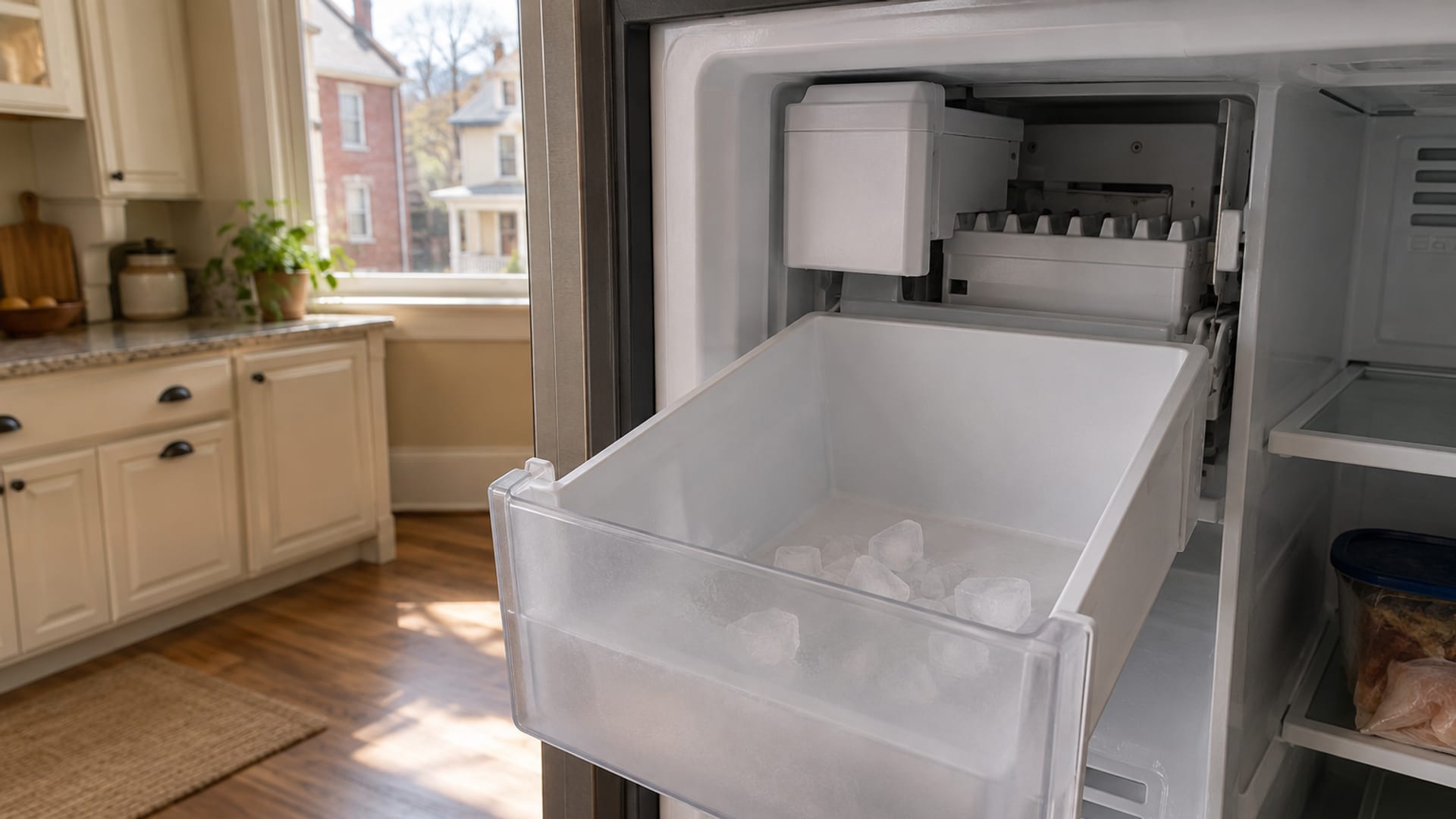
An ice maker that goes quiet is one of the easiest appliance problems to misdiagnose, because six different faults produce the same empty bin. Some take thirty seconds to fix. Some need a part. Here's the order Joey checks them in on refrigerators around Huntington, starting with the things you can do yourself tonight.
Check the Arm or Switch Before Anything Else
Every ice maker has a way to shut itself off when the bin is full — a wire arm that rises as ice stacks up, or a paddle or optical sensor on newer units. It's easy to bump the arm into the "off" position while reaching for the bin, and some models have a small slide switch on the ice maker body that gets flipped when the bin is removed. Make sure the arm is down or the switch is on, then give it a full day. Ice makers only produce a tray every hour or two.
A Frozen Fill Tube Blocks Water to the Mold
Water enters the ice maker through a short tube at the back of the freezer. If the inlet valve doesn't seal completely, a trickle keeps coming after the fill ends, and it freezes into a plug at the tube's tip. Once that happens, no water reaches the mold and the ice maker cycles with nothing in it. You'll often see a lump of ice around the tube or under the ice maker itself.
- Quick fix: unplug the refrigerator, thaw the tube with a hair dryer on low or a warm damp cloth, and restart.
- Real fix: if it refreezes within a week or two, the inlet valve is weeping and needs to be replaced.
The Water Inlet Valve Fails Quietly
The inlet valve is a solenoid at the back of the refrigerator that opens for a few seconds each cycle to fill the mold. Valves fail two ways. A weak coil won't open at all — the ice maker goes through its motions but stays dry. A worn seal doesn't close fully — which causes the frozen fill tube above, and sometimes hollow or oversized cubes. Listen at the back of the fridge during a cycle. A healthy valve gives a short buzz and you'll hear water run. Silence usually means the valve, the wiring, or a module that isn't calling for water.
An Overdue Water Filter Starves the Ice Maker
The refrigerator's water filter is supposed to be changed every six months, and the ice maker is the first thing to notice when it isn't. A clogged filter cuts the fill volume so cubes come out small, then hollow, then not at all. Bypassing the filter temporarily tells you a lot: if ice production picks back up, the filter was the problem. In homes on well water out toward Milton or the Wayne County side, filters clog faster and six months can be too long.
Freezer Temperature Has to Be Cold Enough
The ice maker's thermostat won't start a harvest until the mold reaches roughly 15°F. If the freezer is running at 20°F or warmer, the ice maker sits and waits. Set the freezer to 0°F and check it with a thermometer. A freezer that can't get there has its own problem — a frosted evaporator coil, a failed defrost cycle, or a bad evaporator fan — and the ice maker is just the first symptom. Our freezer repair page covers those.
Cloudy ice is normal. Small ice is a warning. Cloudy cubes come from dissolved air and minerals and are nothing to worry about. Cubes that get progressively smaller point to low fill volume — a tired filter, low household water pressure, or a valve that's on its way out. Catch it early and it's a cheaper fix.
When the Ice Maker Module Itself Is Dead
The module is the motor and control unit that turns the ejector, runs the mold heater, and calls for water. When it fails, the cycle stalls partway — cubes freeze in the mold and never eject, or the ejector arm sits at an odd angle. On most Whirlpool, Maytag, KitchenAid, GE, and Frigidaire refrigerators the whole ice maker head is a replaceable assembly. Samsung and LG units are more integrated and can take a specific part number. Either way it's a straightforward ice maker repair, and on many models Joey has the assembly on the truck.
Small Ice, Hollow Ice, and Cloudy Ice
The shape of the ice you do get is a useful clue:
- Small or thin cubes: low fill — filter, pressure, or valve.
- Hollow cubes with a wet underside: the mold heater is running long or the freezer is too warm.
- Cubes fused into a slab: a weeping valve or a door left ajar letting the bin partially melt.
- Bad-tasting ice: an overdue filter or food odors in an open freezer.
Ice Maker Repair Across the Tri-State
If you've checked the arm, thawed the tube, swapped the filter, and confirmed the freezer is at zero, and the bin is still empty after a day, it's time to call. Tell Lauren the brand, the model number from the sticker inside the fresh-food door, and whether you hear the valve buzz. That tells Joey whether to bring a valve, a module, or both. Most ice maker calls in Huntington, Barboursville, and Ashland are finished the first visit. And if the ice maker is one symptom of a bigger cooling problem, we'll say so — our refrigerator repair page explains what those look like.